support@dragon-dealz.ch
 +1 (888) 303-8337








Why Deals Matter More in Q4
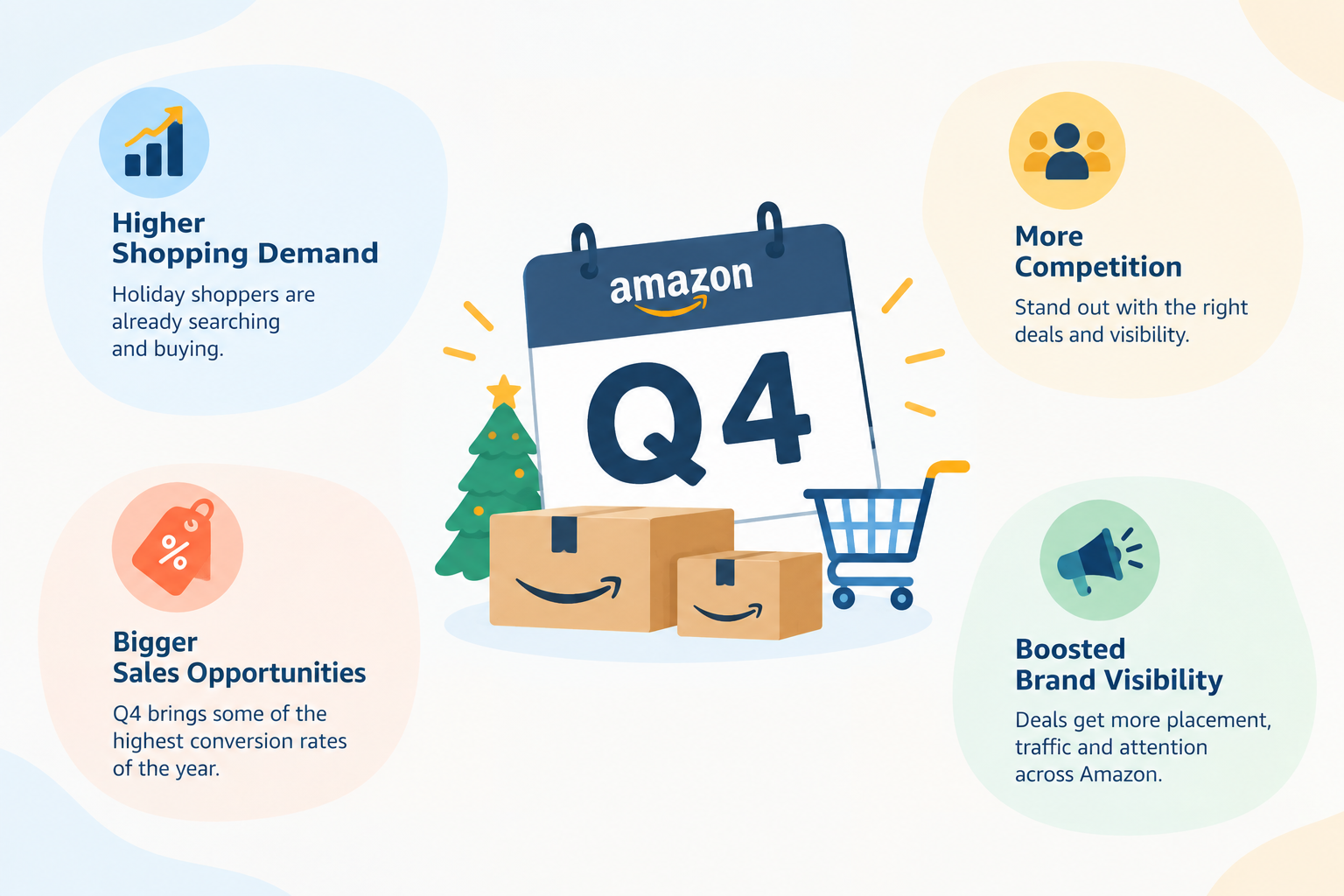
Outside of Q4, a discount is optional. Inside it, non-participation has a cost: Prime Big Deal Days, Black Friday Week, and Cyber Monday pull a disproportionate share of annual traffic onto deal-specific pages, and Amazon’s own algorithm treats the velocity spike from a deal as a ranking signal that can carry into the weeks after the event.
A seller who skips these placements isn’t just missing incremental sales; they’re ceding the review velocity, the badge visibility, and the keyword rank lift to whichever competitor did submit a deal. The rest of this guide treats deal selection as a Q4 planning decision, not a last-minute discount.
Every Amazon Deal Type Explained
Lightning Deals
What it is: A short, flash-sale placement on Amazon’s Today’s Deals page with a countdown timer and a limited unit count.
Where it appears: Today’s Deals page, deal badge on the listing, and Amazon’s deals email/app placements during peak weeks.
Duration: Typically 4–12 hours; Amazon sets the exact start time and length inside the week the seller selects.
Minimum discount: Amazon enforces a required percentage off the product’s historical reference price, commonly in the 15–20% range and often higher during Q4 events.
2026 fee (US): For holiday-period Lightning Deals, Amazon has confirmed a $100 upfront fee per promotion plus a variable fee of 1.5% of promotional sales, capped at $5,000 — the same structure used for Prime Day 2026. Some third-party trackers still cite a flat $150-and-up fee model from earlier in the year; confirm the figure shown at submission time, since it can shift with the week and marketplace traffic.
2026 fee (EU/UK): Structure mirrors the US model, converted to local currency; confirm the exact number in each EU/UK Seller Central account before submitting, since Amazon has not published a single cross-marketplace table.
Best use: A launch or relaunch ASIN with in-stock depth, a 3-star-plus rating, and sales history, where the goal is a short, sharp velocity spike.
Worst use: Thin-margin products, or any ASIN that can’t absorb a stockout risk if the deal sells through faster than expected.
Best Deals (formerly 7-Day Deals)
What it is: A longer-running discount placement on the same Today’s Deals real estate as Lightning Deals, without the countdown urgency.
Where it appears: Today’s Deals page and deal badge on the product listing.
Duration: Up to 7 days, giving more sustained visibility than a Lightning Deal.
Minimum discount: Amazon-set threshold against the reference price, generally similar to Lightning Deal minimums.
2026 fee (US): Same holiday-period structure as Lightning Deals: $100 upfront plus 1.5% of promotional sales, capped at $5,000.
2026 fee (EU/UK): Mirrors the US structure; confirm local-currency figures in-dashboard. Best use: Sellers who want deal-badge visibility across a full week rather than a single-day spike, useful for sustaining rank gains through an entire event window like Black Friday Week.
Worst use: Low-margin ASINs where a full week at a mandated discount erodes more profit than a short Lightning Deal would.
Deal of the Day (Amazon-invited only)
What it is: Amazon’s most prominent single-day deal placement, offered by invitation rather than seller submission.
Where it appears: Featured spot on the Today’s Deals page.
Duration: One day.
Minimum discount: Set by Amazon on a case-by-case basis, typically deeper than a standard Lightning Deal.
2026 fee: Not applicable to seller submission. Amazon selects eligible ASINs internally, usually based on sales history, pricing behavior, and inventory depth.
Best use: N/A for planning purposes; sellers should keep pricing history clean and inventory available so Amazon can extend an invitation.
Worst use: Not a plannable channel; don’t build a Q4 calendar around it.
Prime Exclusive Discounts
What it is: A strikethrough discount visible only to Prime members, carrying a “Prime Exclusive Deal” badge.
Where it appears: Product listing and search results, flagged with the Prime badge.
Duration: Flexible, seller-set within Amazon’s guardrails; can run for days or weeks.
Minimum discount: Lower bar than Lightning or Best Deals in most cases.
2026 fee: Runs on the same holiday promotion fee structure as Best Deals and Lightning Deals when submitted through the Deals dashboard for a Q4 event: $100 upfront plus 1.5% of promotional sales, capped at $5,000. Outside of formal event submission, Prime Exclusive Discounts can also be configured with no additional platform fee, so confirm which path you’re using at submission.
Best use: Reaching loyal Prime shoppers without committing to the shorter, higher-pressure Lightning Deal window.
Worst use: Products with thin Prime-member overlap, where the badge adds little beyond what a standard listing already shows.
Coupons (including Prime member coupons and Subscribe & Save coupons)
What it is: A clippable discount shown as a green or orange tag on the listing and in search results.
Where it appears: Search results and product detail page.
Duration: Seller-set, from days to ongoing.
Minimum discount: Seller-chosen, typically 5–50% off.
2026 fee (US): Amazon replaced the old flat $0.60-per-redemption fee with a two-part structure that scales with product price sellers on lower-priced items (roughly under $22) generally pay less than under the old model, while higher-priced items generally pay more. Amazon has also capped the variable portion of coupon fees at $2,000 per coupon for coupons created from November 5, 2025 onward, which caps downside risk during high-redemption Q4 events.
2026 fee (EU/UK): Same two-part logic applies; confirm the price threshold and cap in local currency before launch.
Best use: Under-reviewed SKUs that need a click-through and conversion boost, or Subscribe & Save enrollment pushes.
Worst use: High-priced items where the redemption-based fee compounds quickly, or products already discounted through another deal type; stacking can erode margin faster than sellers expect.
Promotions (percentage off, buy X get Y, social media promo codes)
What it is: Seller-configured price promotions run outside the formal Deals dashboard, including percentage-off codes, buy-one-get-one structures, and codes distributed for social/influencer use.
Where it appears: Not typically badge-visible on the listing; discovered via the code the shopper enters or a linked landing page.
Duration: Fully seller-controlled.
Minimum discount: No Amazon-enforced floor.
2026 fee: No separate platform fee beyond the discount itself in most cases; sellers fund only the price reduction.
Best use: Influencer and social campaigns where the discount needs to be trackable outside organic search, or flexible offers that don’t fit a fixed Deals-dashboard format.
Worst use: Driving organic search rank because these promotions carry no badge and no Today’s Deals placement; they don’t produce the same velocity signal as Lightning or Best Deals.
H3: Brand Tailored Promotions
What it is: Targeted discount codes sent to specific, pre-qualified customer segments, brand followers, repeat customers, cart abandoners, and high-spend shoppers available to Brand Registry sellers.
Where it appears: Delivered directly to the qualifying audience rather than shown broadly in search.
Duration: Seller-set campaign windows.
Minimum discount: Amazon allows offers from roughly 10% to 50% off; minimum qualifying audience size is now 1,000 customers for most segments (Brand Followers is a common exception).
2026 fee: No separate setup or platform fee; the seller funds only the discount amount, which makes this one of the lowest-cost tools on this list.
Best use: Retention and re-engagement plays aimed at people who already know the brand are a good complement to a Q4 deal rather than a replacement for one, since it doesn’t carry Today’s Deals visibility.
Worst use: New customer acquisition at scale, since the tool is built around segments who already have some relationship with the brand.
Outlet Deals
What it is: A clearance-style discount placement for excess or aging inventory, presented in a dedicated outlet section.
Where it appears: Amazon Outlet storefront and, in some cases, on the product listing itself.
Duration: Typically longer-running than event deals, until inventory clears.
Minimum discount: Deeper than standard promotions, reflecting the clearance positioning.
2026 fee: Runs closer to a standard discount mechanic than a paid promotion slot; sellers should confirm current terms in the dashboard, as Outlet program terms are updated more quietly than headline Q4 promotions.
Best use: Clearing overstock before long-term storage fees apply, particularly ahead of the Q4 storage fee window.
Worst use: Hero or best-selling ASINs; the clearance framing can undercut full-price positioning if used on a product’s core inventory.
Subscribe and Save
What it is: A recurring-delivery discount funded primarily by the seller, aimed at converting one-time buyers into repeat subscribers.
Where it appears: Product listing, with a Subscribe & Save option alongside the standard buy box.
Duration: Ongoing, tied to the customer’s subscription.
Minimum discount: Seller-configured within Amazon’s allowed range.
2026 fee: No per-redemption platform fee; the cost is the ongoing discount itself, funded by the seller over the life of each subscription.
Eligibility: Requires Brand Registry enrollment, a strong fulfillment track record, an in-stock rate above roughly 90%, and pricing that hasn’t been artificially inflated ahead of the discount.
Best use: Consumable or replenishable products where the goal is durable, repeat revenue rather than a one-time Q4 spike.
Worst use: One-time-purchase categories, or ASINs without the fulfillment consistency to support ongoing subscriptions through Q4’s peak fulfillment period.
Event Placements (Prime Big Deal Days, Black Friday Week, Cyber Monday)
What it is: Not a separate deal mechanic; these are the Q4 windows in which Lightning Deals, Best Deals, and Prime Exclusive Discounts can be submitted for premium, event-branded placement.
Where it appears: Dedicated event landing pages in addition to the standard Today’s Deals page.
Duration: Fixed by Amazon’s event calendar; submission windows close well before the event itself.
Minimum discount: Typically the highest bar of the year, since Amazon enforces stricter price-history rules to ensure discounts are genuine ahead of major events.
2026 fee: Same $100 upfront / 1.5%-of-sales structure (capped at $5,000) that applies to standard holiday Lightning Deals, Best Deals, and Prime Exclusive Discounts. Amazon has confirmed no new fee tier specifically for event placements this year.
Best use: ASINs that are already deal-tested earlier in Q4 and have the inventory depth to survive the highest-traffic days of the year.
Worst use: Untested ASINs being submitted for the first time on the biggest event of the season; the price-history and eligibility bar is unforgiving of last-minute entries.
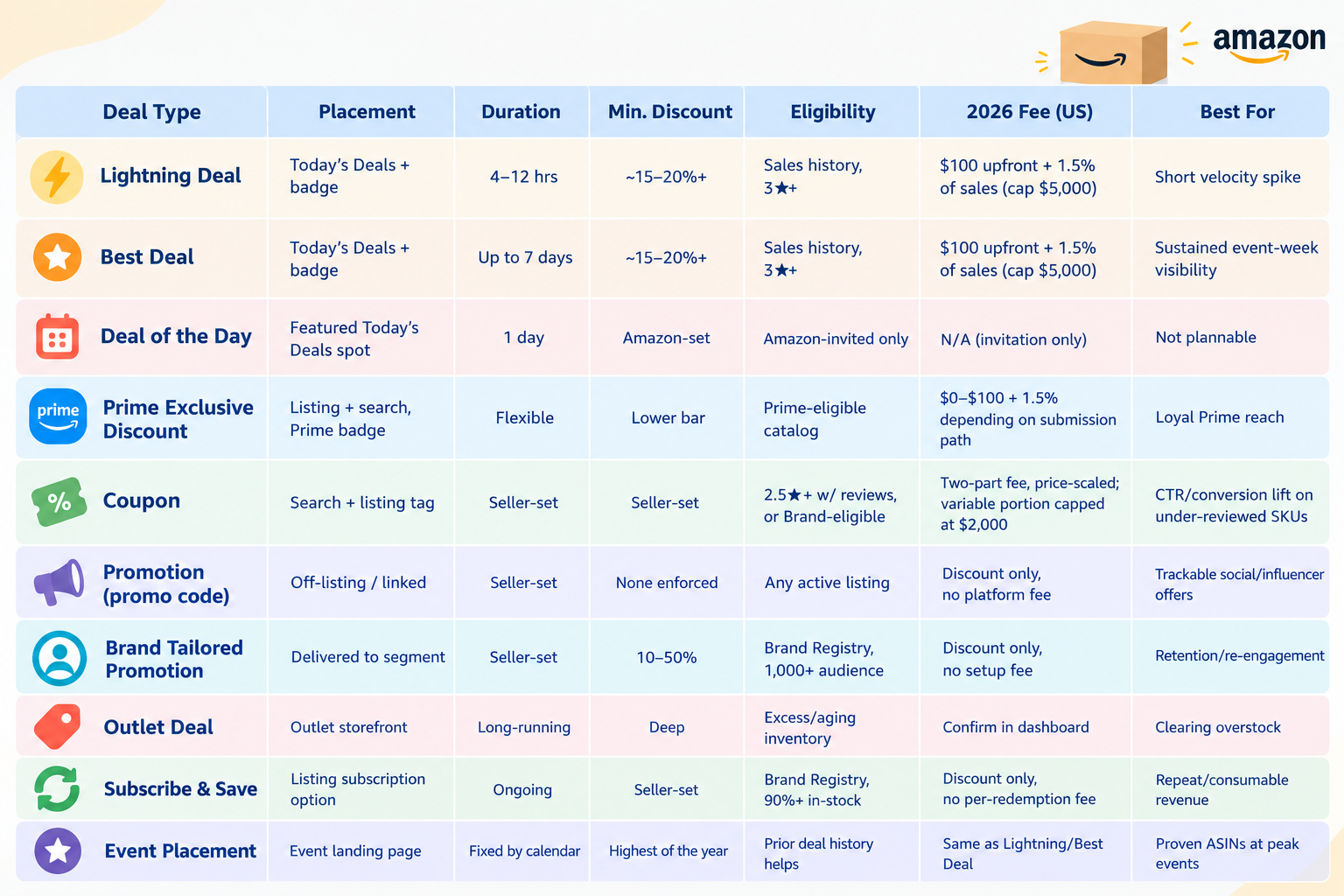
Comparison Table
Why Sellers Should Participate
Several of these placements simply aren’t available any other way: Today’s Deals, the event landing pages, and the Prime badge are gated behind formal deal submission, not something an ad budget can buy directly. Beyond access, the sales velocity a deal generates is one of the more reliable levers for the ranking algorithm; a concentrated burst of orders and the review velocity that follows tends to carry into organic position for a period afterward, though the exact duration varies by category and competitive set. Deals also put the ASIN in front of Prime shoppers who filter specifically for deal badges, and they’re a legitimate way to move excess inventory before Q4’s long-term storage fees kick in.
One 2026-specific mechanic worth planning around: an October deal price does not set a price ceiling that caps how deep a later Black Friday Week deal can go, so an early-Q4 discount doesn’t lock out a deeper move later in the season.
Pros and Cons
Pros
- Access to placements (Today’s Deals, event pages, Prime badge) unavailable outside the Deals dashboard
- Velocity and review-count lift that can support organic rank after the deal ends.
- Reach into the Prime shopper segment specifically browsing deal pages
- A practical way to clear excess stock ahead of peak-season storage fees
Cons
- Margin erosion from the mandated discount stacked with the promotion fee
- Stockout risk if a deal sells through faster than forecast, or unsold committed units if it underperforms
- The deal price can become the new reference price Amazon uses for eligibility on future promotions
- Some deal-driven sales are simply pulled forward from days the customer would have bought at full price anyway
- Rank gains from the velocity spike can fade once the deal-driven order flow stops
Which Deal for Which Goal
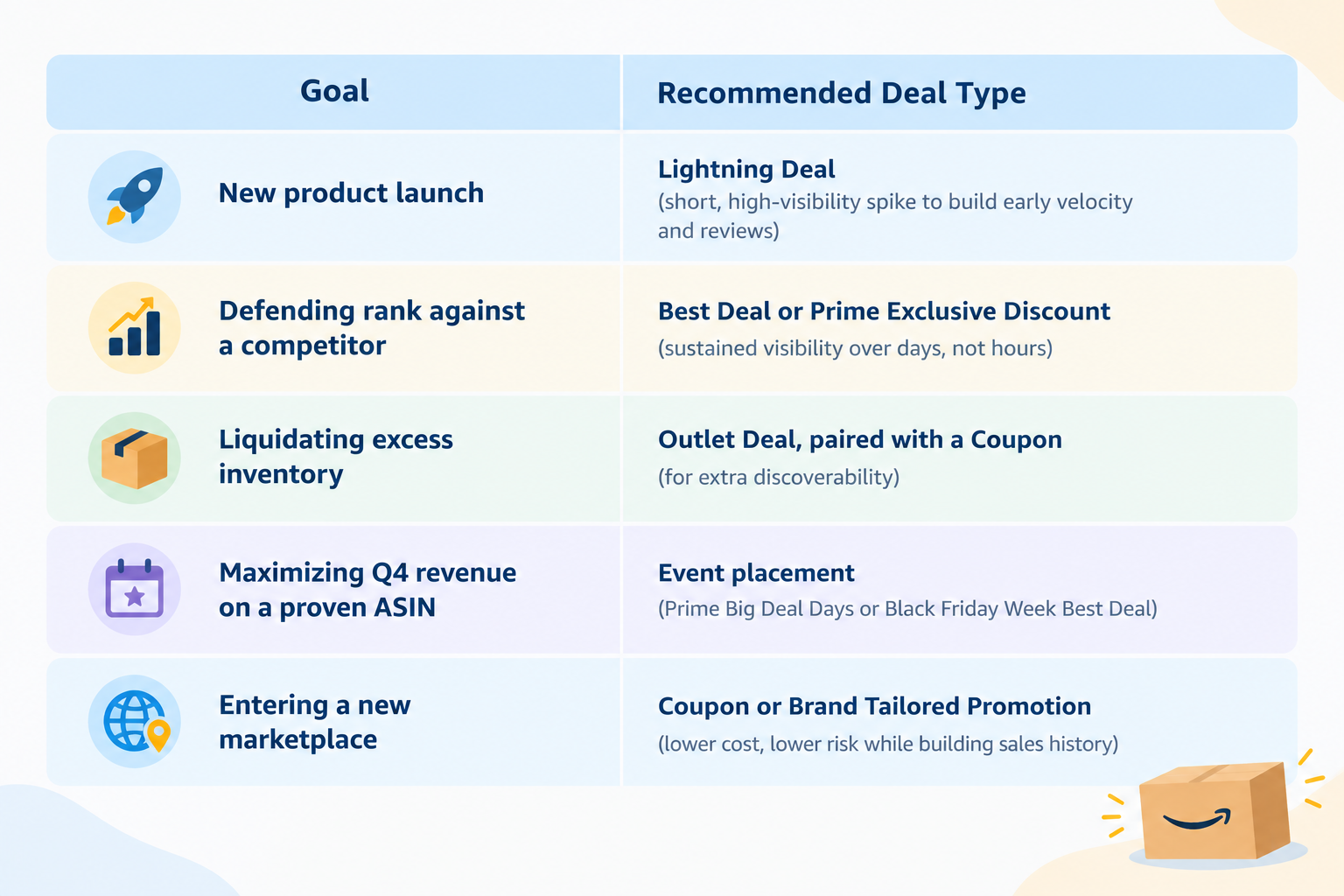
A Sample Q4 Plan for One ASIN
Product: A $28 home-goods item, 32% gross margin, healthy review base, 4.3★.
- September – Coupon: 15% off ($4.20). Targeting the sub-$22 fee tier is not applicable here since the item is over $22, so the higher-tier redemption fee applies. Budget for roughly 300 redemptions: $1,260 in discount plus a price-scaled platform fee (confirm the exact per-unit fee for this price band in-dashboard, since the two-part structure changes at different price thresholds).
- October – Prime Exclusive Discount: 20% off during a mid-October window to build a deal-eligible price history ahead of Black Friday Week, without triggering the “October price caps November discount” concern, since Amazon’s 2026 rule explicitly removes that cap.
- Black Friday Week – Best Deal: 25% off for the full event week. Fee math: $100 upfront + 1.5% of promotional sales. On a projection of 800 units at the $21 discounted price ($16,800 in promotional sales), the variable fee would be $252, for a total promotion fee of $352, well under the $5,000 cap.
Total promotional cost across the quarter: roughly $1,260 (coupon discount) + coupon platform fees (confirm exact figure) + October discount cost + $352 (Black Friday Week fee), against a combined revenue lift the seller should model against their own conversion history before committing. This is illustrative, not a guarantee, so run the same math against your actual sell-through data before submitting.
FAQ
Amazon Deals
Generally not on the same ASIN in a way that stacks cleanly. Amazon typically applies the single best eligible discount rather than layering a coupon on top of an active Lightning Deal price. Check current stacking rules in the dashboard before scheduling both.
The most common reasons are insufficient sales history, a star rating below the threshold, an inconsistent in-stock rate, or a price history that doesn’t support the minimum discount Amazon requires against the reference price. Brand-new ASINs with no sales history typically need to build some organic sales first.